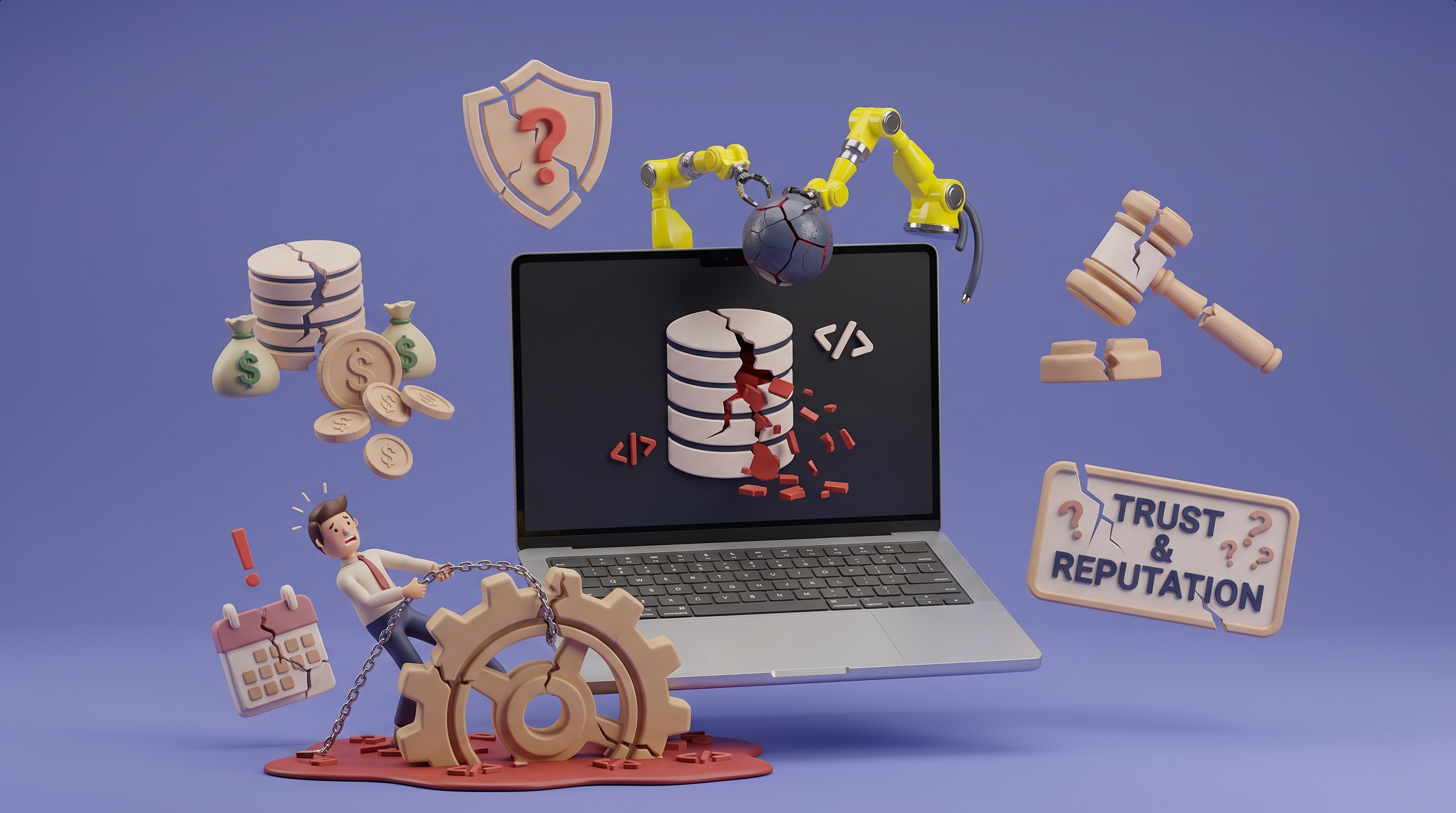
Three days after a SaaS product launched, the founder discovered their user database had been exposed ??? 40,000 records pulled through an API endpoint left open during QA. The attacker didn't break anything. They just walked through an unlocked door. The breach cost them legal fees, three weeks of engineering time, and a churn spike that took nearly a year to stabilize.
That scenario isn't hypothetical. It's a composite of breach patterns that repeat across startups and growing businesses every quarter. And the thing almost every founder says afterward is the same: "We thought we were too small to be a target."
The Real Cost Calculation
Most founders think of a data breach in terms of the ransom or the fine. That's the visible cost ??? and usually the smallest part. The actual damage spreads across at least four categories.
Direct costs include incident response (hiring forensic engineers to understand what happened and contain it), legal fees, and regulatory exposure. In the EU, GDPR fines can reach 4% of annual global turnover. Pakistan's Personal Data Protection Act (PDPA) creates real liability for any business handling citizen data ??? and that's a risk most local founders haven't fully priced in.
Indirect costs hit harder and are harder to see. Customer churn after a breach is not linear ??? trust collapses fast and rebuilds slowly. IBM's Cost of a Data Breach 2024 report puts the global average breach cost at $4.88 million, with $1.47 million attributed specifically to lost business and reputational damage. That figure skews toward enterprise, but the ratio holds at smaller scale.
Engineering time is the one nobody budgets. Three to eight weeks of senior developer hours spent on forensics, patching, re-architecting authentication, and writing post-mortems is time that doesn't ship features. For a five-person team, that's a meaningful chunk of a quarter gone.
Where Breaches Actually Come From
The mental model most business owners have is that hackers are sophisticated actors targeting specific companies. The reality is that the majority of web application breaches exploit known, catalogued vulnerabilities ??? the kind documented for years in the OWASP Top 10. Injection attacks, broken authentication, security misconfigurations, and exposed sensitive data in APIs account for the bulk of incidents. These aren't zero-day exploits. They're the digital equivalent of leaving the front door open.
The specific patterns that show up most often in web application breaches:
Unauthenticated API endpoints left over from development or QA environments
Hardcoded credentials or API keys committed to version control
Session tokens with no expiry and no rotation policy
Admin panels reachable at
/adminwith default credentials still in place
Any of those four could exist in a codebase that passed QA and went to production without a security review. None of them require a sophisticated attacker to exploit.
"We're Too Small to Be a Target" Is the Most Expensive Belief in Business
Opportunistic attacks are automated. Bots scan the internet constantly for exposed endpoints, misconfigured S3 buckets, open database ports, and known CVEs. They don't care whether you're a Series A startup or a 50-year-old manufacturing company with a new web portal. They probe every reachable IP address.
Small and mid-sized businesses are actually preferred targets in certain threat models ??? they hold valuable data and have fewer defenses than enterprise. The calculus is simple: more accessible, similar reward. A founder who launches without a security review isn't making a calculated risk decision. They're making an uninformed one, because they haven't priced in the true downside.
What Proactive Security Actually Looks Like
Security isn't a feature you add at the end of a project. It's an approach baked into architecture decisions, code review, deployment pipelines, and vendor selection. For a growing business, the practical baseline includes access controls that follow the principle of least privilege, dependency management that flags and patches known CVEs before they're exploited, and proper implementation of authentication standards like OAuth 2.0 and OpenID Connect rather than home-rolled auth.
Penetration testing is the one businesses most often skip because it feels like a luxury. It isn't. A well-scoped pentest typically costs a fraction of what a single incident response engagement costs ??? and it tells you where your exposure is before an attacker finds it first. Code audits, infrastructure reviews, and third-party security assessments aren't compliance theater. They surface the gaps that internal teams are too close to see.
A well-scoped pentest typically costs a fraction of a single incident response engagement ??? and it tells you where your exposure is before an attacker finds it first.
Choosing the Right Security Partner
If you're evaluating cybersecurity services in Karachi or anywhere in Pakistan, the things worth scrutinizing are different from what's on most vendor brochures. Certifications matter ??? CEH, OSCP, and CISSP are real indicators of competence ??? but the more important question is whether the team can work alongside your engineering team, not around them.
Security work that results in a 200-page PDF report nobody reads is not security work. What actually moves the needle is a partner who can explain vulnerabilities in terms your developers understand, prioritize by actual risk rather than theoretical severity, and help you build processes that prevent the same class of issue from recurring.
Look for teams that handle application security alongside infrastructure security. An agency that only manages firewalls and antivirus is solving the wrong problem for a company whose product is a web application. The businesses that get this right treat security as an ongoing relationship ??? not a one-time audit. They have someone to call when a dependency has a critical CVE, when they're about to launch a feature that touches payment data, or when something in the logs looks off.
Start with a security audit if you don't have one. The cost of finding out what's exposed on your terms is always lower than finding out on an attacker's.