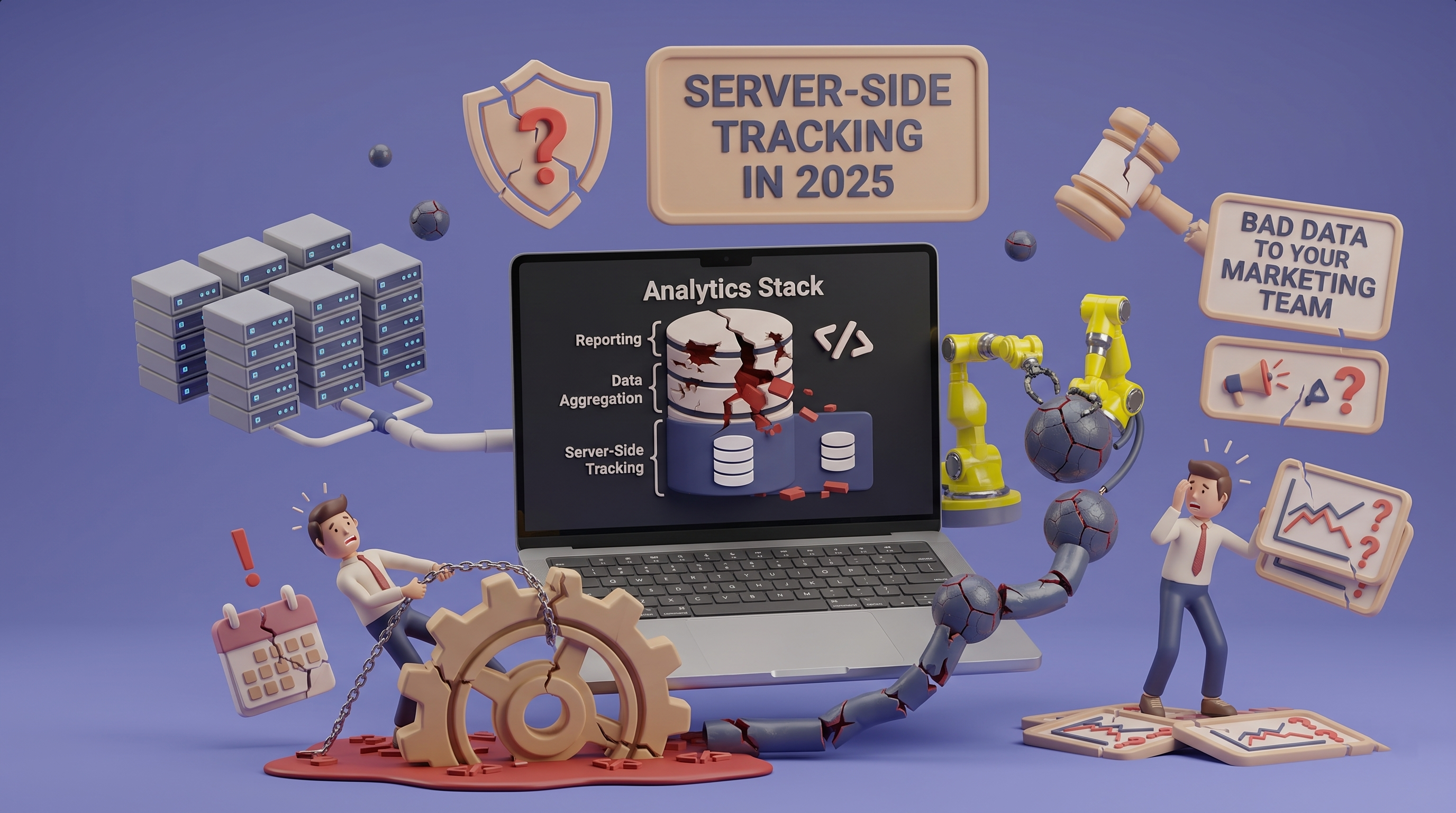
Your Google Analytics is lying to you. Not randomly ??? systematically. Ad blockers remove roughly 20???30% of client-side events depending on your audience. Safari's Intelligent Tracking Prevention caps JavaScript-set cookies at 7 days. Browser extensions like uBlock Origin block GTM containers outright on any setup that serves a technical audience. If your marketing team is making bid adjustments and budget calls based on conversion data from a standard GA4 + client-side GTM stack, they are optimizing against numbers that are structurally wrong.
Why Client-Side Tracking Breaks
The core problem is that client-side tracking hands control to the browser ??? and the browser does not have to cooperate. A tag inside a Google Tag Manager container fires JavaScript on page load, which means any extension watching network requests can kill it before it runs. uBlock Origin pattern-matches googletagmanager.com and blocks the entire container, taking GA4, Meta Pixel, LinkedIn Insight Tag, and every other tag with it. In developer-heavy audiences, adblocker penetration regularly runs above 40%.
Safari's ITP is a separate, compounding problem. Even when tracking fires cleanly, any cookie set via document.cookie gets a 7-day expiration cap enforced by the browser. A user who starts a trial on Monday, uses the product through the week, and converts on day 10 via Safari? Your attribution model has no record of the acquisition source. The sale looks unattributed, the original channel gets no credit, and your budget allocation shifts ??? not toward channels that are more effective, but toward channels that are simply better at not being blocked.
Server-Side GTM: The Architecture Shift
Server-Side Google Tag Manager relocates tag execution from the user's browser to a server you control. Instead of loading gtm.js in the browser, your site sends events to a first-party endpoint ??? typically a Cloud Run container ??? which forwards those events to GA4, Meta CAPI, Google Ads, and any other destination. From the browser's perspective, all traffic goes to your own domain. There is nothing for an ad blocker to pattern-match.
The deployment involves three components: a Server-Side GTM container separate from your standard web container, a containerized server endpoint that Google provides as a ready-to-deploy Docker image, and a custom subdomain pointed at that server ??? something like analytics.yourdomain.com. Once your web GTM container is configured to route events to this endpoint instead of Google's servers, all tag execution moves server-side. The change is invisible to users and invisible to blockers.
First-Party Cookies Done Right
This is where the attribution window problem gets solved properly. When your server sets a cookie via the Set-Cookie response header, it is an HTTP cookie set by your own origin ??? not a JavaScript cookie. Safari's ITP only restricts cookies written via document.cookie. A server-set cookie with an explicit expires attribute can persist for up to 400 days ??? the standard GA4 client ID window ??? surviving browser privacy restrictions entirely.
The practical implication extends further than it first appears. Any multi-touch attribution model, any return visitor analysis, any cohort built on this data is now working from accurate session linkage rather than a fractured view of the same user appearing as multiple new visitors. You stop overcounting acquisition and undercounting retention ??? and those two distortions alone explain a significant portion of why CAC numbers look worse than they actually are.
Meta CAPI and Why Hybrid Is the Right Model
The same structural fix applies to Meta. The Meta Pixel fires client-side and gets blocked. Meta's Conversions API fires server-to-server, never touching the browser. Meta's recommended implementation is a hybrid: keep the Pixel for real-time browser-side signals and run CAPI as a parallel channel, deduplicating on both sides by passing a matching event_id. In practice, this approach recovers 10???20% of conversion events that were being silently dropped ??? events that were already happening, just invisible to the optimization algorithm.
That matters more than the percentage suggests. Meta's delivery algorithm trains on your conversion signal. If 20% of your conversions are invisible to it, the algorithm is training on a biased dataset and mis-allocating delivery. You end up paying more for worse placements because your signal looks artificially weak, and the algorithm compensates by being conservative.
Is The Stack Worth Building?
A complete server-side tracking implementation in 2025 covers four layers. Server-Side GTM deployed to Cloud Run, proxied behind a first-party subdomain. GA4 events routed through that server, with client_id persisted in a server-set HttpOnly cookie. Meta CAPI running in parallel with the Pixel, deduplicating by event_id. And Google Ads Enhanced Conversions sending hashed user data server-to-server for improved match rates on logged-in users.
This is not a marketing operations project. It is an infrastructure project. The implementation lives in your server config, your CDN routing rules, your deployment pipeline. Which is exactly why it rarely gets done by marketing teams working in isolation ??? and why a digital marketing agency in Karachi that operates at the engineering layer, like Xtenzium, treats this as a backend problem with marketing consequences rather than a marketing problem that happens to involve code.
The teams that get server-side tracking right end up with a compounding advantage: their optimization algorithms train on real conversion data, and their budget decisions carry a structural signal edge over every competitor still running on broken numbers.
The uncomfortable truth is that most teams will not do this work. It requires engineering buy-in, legal review ??? the GDPR and PDPA implications of server-side data handling differ materially from client-side ??? and careful deduplication logic to avoid inflating conversion counts. None of that is trivial. But the teams that clear those hurdles are not just tracking better; they are making systematically more accurate allocation decisions than everyone still operating on structurally incomplete data.
The question is not whether your current tracking is missing conversions. It almost certainly is. The real question is how many budget cycles you plan to run before fixing the infrastructure underneath them.